// The systems read, in writing
Why OpenAI Refuses to Own the Ground It Runs On: The Hidden Strategy of AI Infrastructure
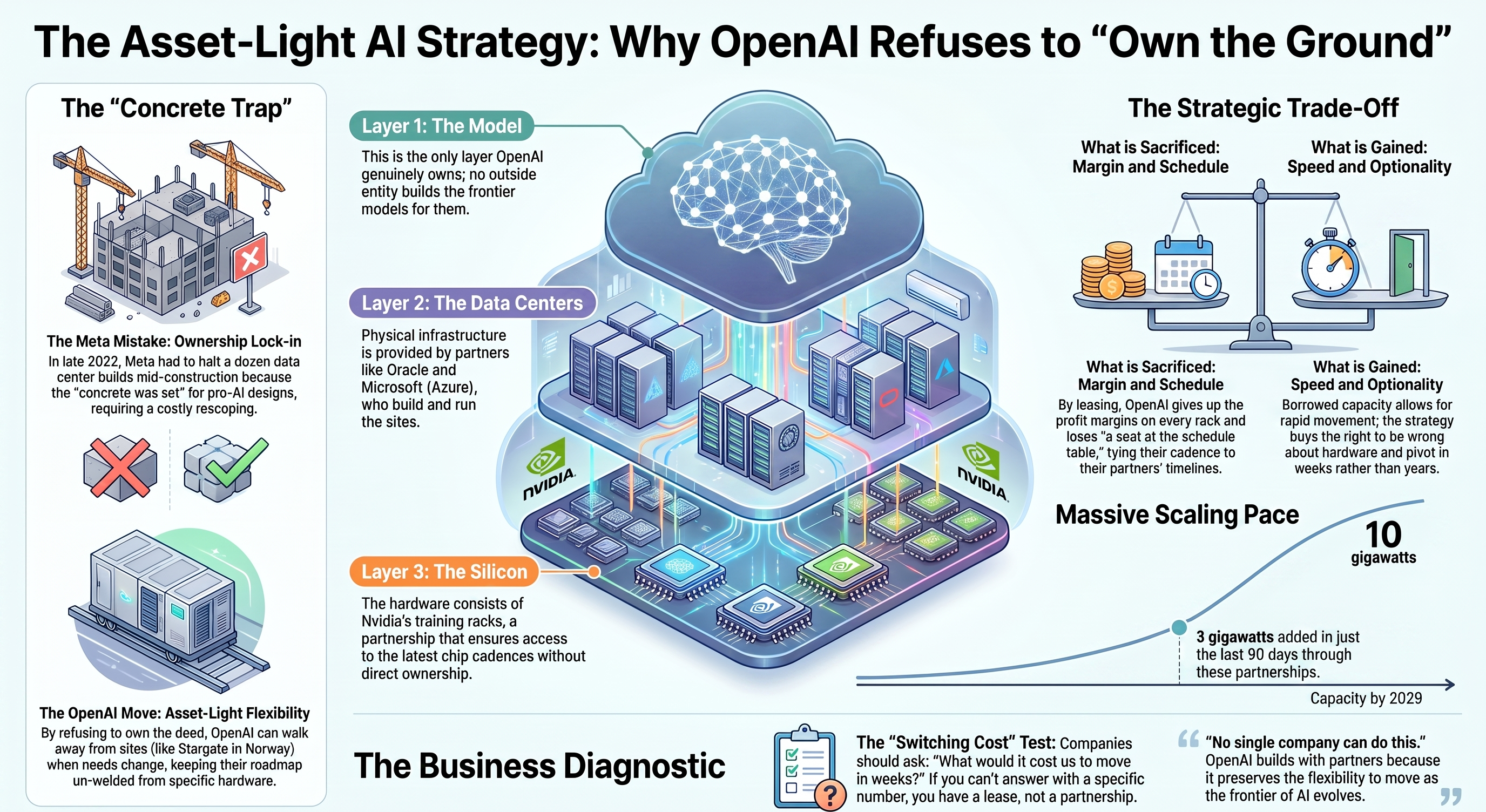 Download the one-page infographic
Everyone photographs the model. Almost nobody looks at the ground it runs on. In the high-stakes race for artificial intelligence supremacy, there is a profound strategic paradox at the center of the industry’s leader. While the world focuses on the sophisticated logic of OpenAI’s frontier models, the physical infrastructure supporting that intelligence is a patchwork of third-party assets. OpenAI has made a deliberate architectural choice: the strategic decoupling of the physical and logic layers. They refuse to own the ground they run on. Consider the model trained at a site in Abalene, Texas. While the intelligence is OpenAI’s, the infrastructure tells a different story. It ran on Oracle’s cloud using chips designed by Nvidia, bypassing Microsoft Azure entirely for that specific project. This raises a central question for any business architect: Why would a multi-billion dollar company choose to "lease" its future? The answer lies in a calculated trade of ownership for extreme optionality.
The Three-Layer Architecture: A Strategic Divorce
To understand this strategy, one must view the AI stack as a system split into three distinct, decoupled layers. By separating these layers, OpenAI ensures that while its logic remains sovereign, the physical environment remains swappable.
Layer 1: The Model (Logic Layer): This is the only layer OpenAI genuinely owns. It is their core intellectual property and the "photograph" the world sees. No one else is building these for them.
Layer 2: The Data Centers (Physical Layer): These are the shells and power systems. Currently, providers like Oracle build and manage these facilities.
Layer 3: The Silicon (Hardware Layer): This is the specialized hardware required for training, dominated by a partnership with Nvidia that dates back to 2016. The significance of this divorce was demonstrated by the " Stargate" capacity shift. OpenAI moved frontier model training from Microsoft Azure to Oracle. Because they are not tied to the "concrete" of a specific provider, they can shift the weight of their research to wherever capacity is most available. The ultimate proof of this architecture's success is operational: OpenAI shipped its flagship model into Microsoft’s Copilot seamlessly during the transition to Oracle infrastructure. The user never felt the shift because the logic layer was effectively insulated from the physical migration.
The "Concrete Trap": Why Owning Is a Liability
In a period of rapid technological flux, physical ownership "freezes" a company’s roadmap. When you own the deed and the building, you are making a decade-long bet on a specific architectural design. This is the " Concrete Trap. "The risk is best illustrated by Meta’s experience in late 2022. Meta owned its data centers and paid for them outright. However, when the AI shift accelerated, they were forced to stop construction on approximately a dozen sites mid-build. The concrete had already been set for a pre-AI design, requiring them to tear back and rescope at immense cost. Their failure was not one of vision, but of commitment to a rigid physical footprint. "Pour the concrete, commit to one chip generation, and you've welded your roadmap to something you can't move for a decade. "
The "Right to Be Wrong": Trading Margin for Speed
OpenAI’s refusal to own the full stack is a clinical trade-off. They have declined to capture the "margin on every rack" and have sacrificed a seat at the scheduling table. In exchange, they have bought the "right to be wrong" about hardware and the ability to survive that error. The scale of this commitment is staggering: 10 gigawatts (GW) of capacity by 2029. The speed of execution confirms the strategy; they have added more than 3 GW in the last 90 days alone. This pace would be impossible if the company were bogged down in property management and construction. OpenAI executives justify this by stating they build with partners "because no single company can do this and it preserves flexibility. " In an architectural context, "preserves flexibility" is code for the ability to move instantly when a superior technology or power source emerges.| The Strategic Trade | What is Given Up | What is Gained || ------ | ------ | ------ || Financials | Margin on every rack | Capital efficiency / Opex model || Control | Seat at the scheduling table | Speed and rapid scaling || Risk Profile | Dependency on partner "willingness" | Protection from the " Concrete Trap" |
The Stargate Pivot: The Power to Walk Away
The power of this optionality was proven at a " Stargate" site in Norway. OpenAI originally signed on as the anchor customer. However, when Microsoft took over the site, OpenAI exercised its right to walk away. To an outside observer, this might look like a failure to secure a site. To a business architect, it is a successful execution of mobility. A company holding the deed to that land would have been trapped, forced to manage a complex transition or absorb a massive stranded asset. By remaining a customer rather than an owner, OpenAI treated the infrastructure as a swappable component.
Conclusion: The Diagnostic for the AI Era
The trade OpenAI has made is clear: they are borrowing capacity to buy speed and optionality. They have accepted a different kind of risk—one where they are dependent on a partner’s willingness to build. However, that "willingness" is not a mood; it is a term renegotiated on someone else's schedule. As AI continues to evolve, this model provides a diagnostic for any organization: " Which part do you actually control, and what is the switching cost of everything you don't? "If you cannot define your ability to move in a specific number of weeks, you haven't built a partnership; you have signed a lease you cannot escape. In the AI era, true power does not lie in owning the asset, but in the strategic ability to walk away from it.